
Tree-hugging genocide
More than a century after his death, Belgium is still whitewashing Léopold's crimes in Congo.

A king responsible for genocide is hailed as a tree-hugger in Brussels.
The dark green panel at one entrance of Parc Josaphat explains how it owes its existence to Léopold II.
At the dawn of the 20th century, the main landowner in the surrounding valley was a widow known as Martha. She was the main obstacle Léopold faced when he sought to transform the area into a wooded park.
Hoping to frustrate Léopold’s plans, Martha put a large number of trees up for sale, on the condition that they would be chopped down.
Plucky Léopold then came to the rescue by surreptitiously buying the trees and presenting them as a gift to the local authority. And so the trees were saved by a monarch “who appreciated the beauty of the valley,” the panel informs us.
Not everyone is familiar with Léopold’s heroism. Readers of Adam Hochschild’s King Leopold’s Ghost would probably regard him as synonymous with plunder.
By some estimates, Congo’s population was halved because Léopold wanted a slice of Africa he could call his own.
The colonization he oversaw from 1885 to 1908 cost around 10 million lives during that period and the ensuing decade.
It involved forced labor, massacres, kidnapping, rape, torture, mulilation, the brazen theft of natural resources. The brutality continued following his reign, with Belgium operating an apartheid system until granting Congo a nominal independence in 1960.
Parc Josaphat is located in the Schaerbeek neighborhood of Brussels.
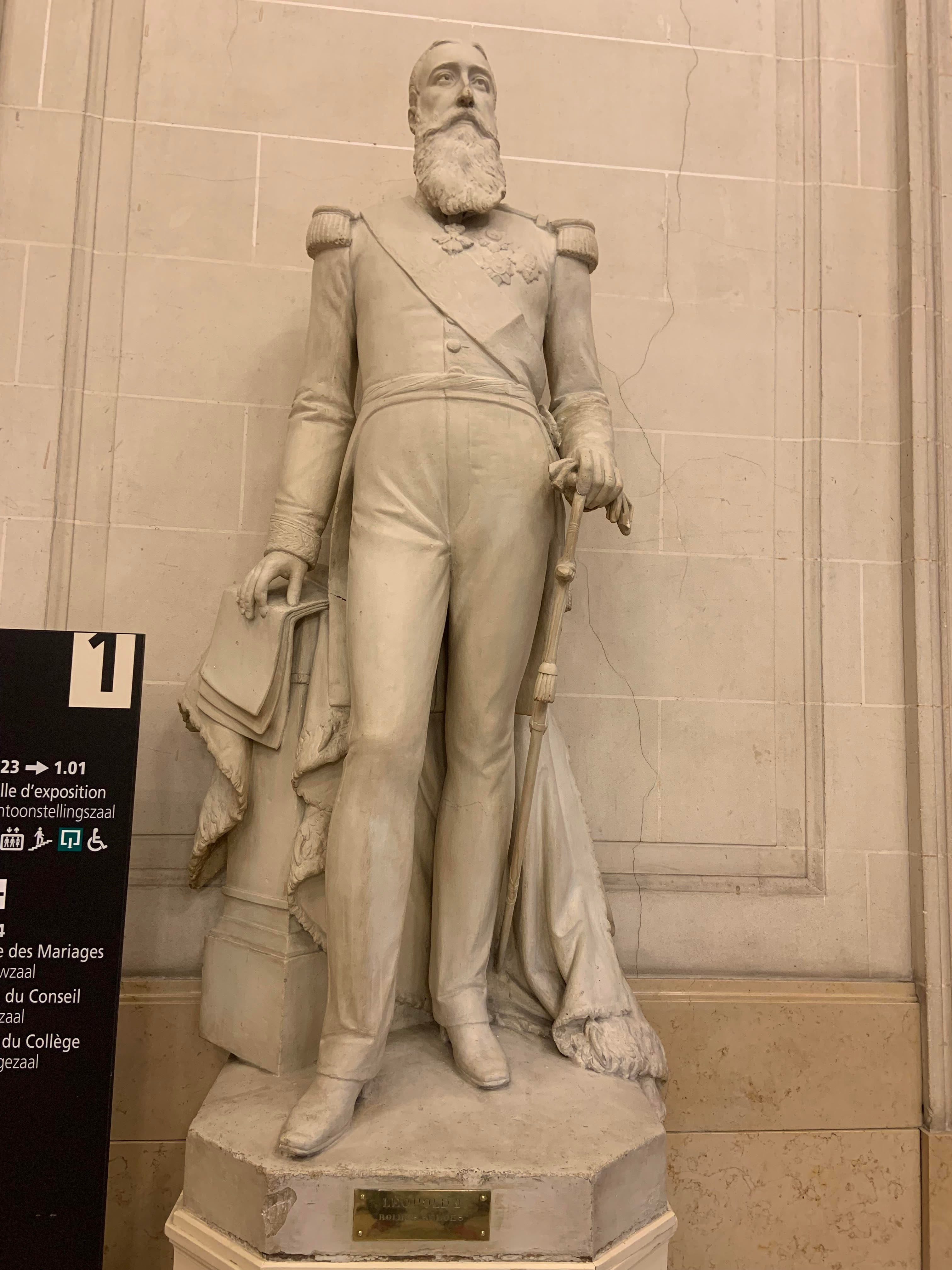
I recently paid a visit to the local town hall. Right beside the mayor’s office, I found a huge white statue of Léopold, cutting a magisterial figure with his long beard and a walking stick.
“King of the Belgians,” the plaque beneath reads.
Although Léopold has been dead for well over a century, he is still celebrated by official Belgium.
The panel portraying him as a tree-hugger at the entrance to Parc Josaphat is not an exception.
Potted histories offered by the administrators of many other outdoor attractions note that they were developed at Léopold’s initiative. The fact that they were financed by ill-gotten revenues from Congo is usually not considered worthy of mention.
Baby steps towards greater transparency are admittedly being taken.
Brussels has designated 2023 the year of Art Nouveau.
Numerous elegant buildings in the city are linked inextricably to colonial marauding.
One exhibition held as part of the Art Nouveau celebrations acknowledges that the genre was first known as Style Congo and that it relied heavily on African raw materials.
The houses open to the public during the Art Nouveau celebrations include the residence of Edmond van Eetvelde, who headed the Belgian administration in Congo. The marble, hardwood and copper used in its construction were all stolen from that country.
Not surprisingly, Belgium isn’t owning up to much theft.
Last year, the Brussels media reported that of 84,000 items from Congo kept in the notorious AfricaMuseum, just 1% were regarded as stolen or bloodstained. The small number included a skull of a tribal chief who had been decapitated during an exhibition led by a Belgian general.
The museum in question was also built at Léopold’s behest.
In 2018, the museum was supposedly modernized - following a major renovation program.
The program ushered in changes to the various displays based on historical analysis and a little consultation with the Congolese diaspora. Yet as Nicholas Lewis writes in the book Colonial Tales, Trails and Traces, the exercise did not properly challenge myths.
The grim reality is the Congo’s colonisation was an act of larceny on a grand scale. Everything connected with the project should be viewed as tarnished.
Léopold II began the project and so long as he is applauded for saving a few trees, Belgium will never make amends for its grotesque record.