
Why does Europe continue to support Israel?
Brussels pays to play by America's rules.

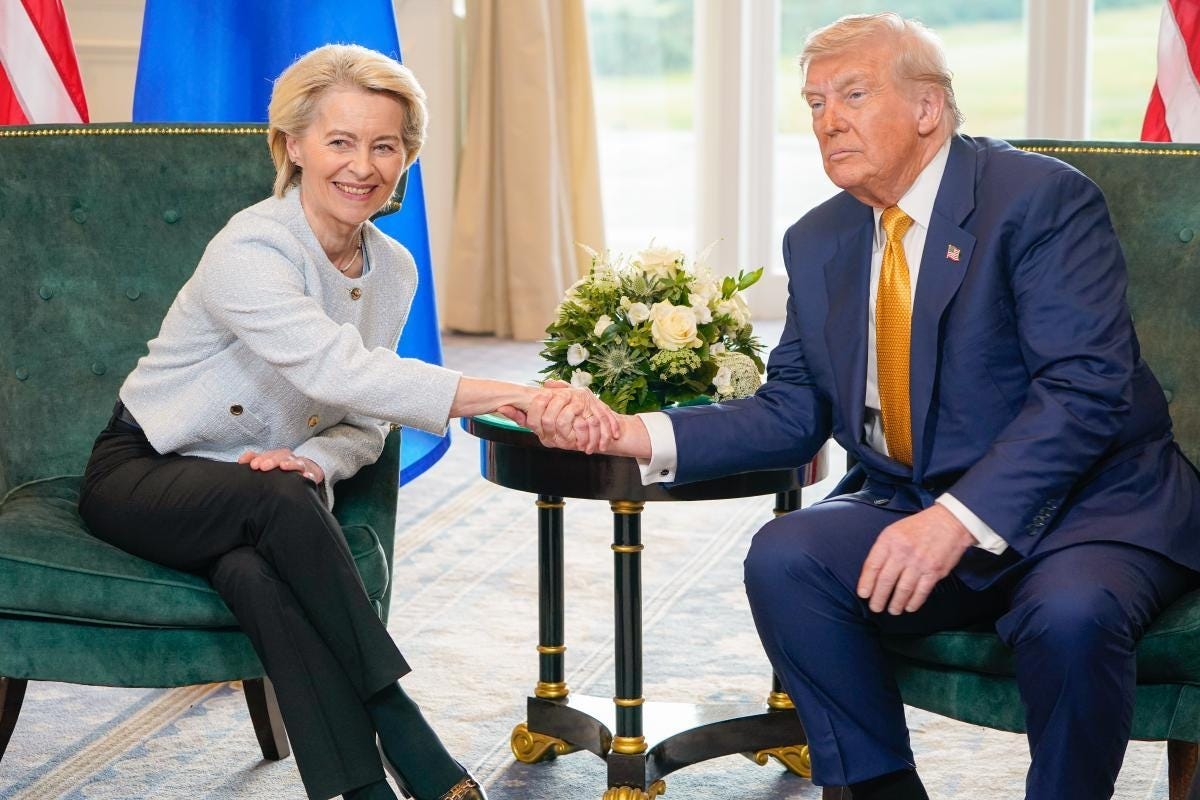
Ursula von der Leyen and her boss. (Fred Guerdin/European Union)
Addressing the question “why does Europe continue to support Israel?” requires a skeptical approach towards the official narrative.
Statements issued by the Brussels bureaucracy are replete with commitments to international law and “values” such as human rights and democracy. On 13 October 2023, Ursula von der Leyen succeeded in discrediting all such commitments by uttering four words that should forever haunt her: “Europe stands with Israel.”
Von der Leyen made that declaration on the same day that Raz Segal, a Holocaust scholar, published an article, describing Israel’s violence against Gaza as a “textbook case of genocide unfolding in front of our eyes.”
Despite subsequently calling attacks on Gaza’s civilian infrastructure “abhorrent,” von der Leyen has never repudiated her “Europe stands with Israel” declaration, even though it, too, was abhorrent.
There are a number of factors that help explain why von der Leyen and other senior EU figures would back Israel as it wages a war of extermination. I have compiled a list of such factors; they are not in any particular order.
1. America is the boss
The year 2026 had barely begun when the United States bombed Venezuela and kidnapped Nicolás Maduro, that country’s president, and his wife. The haste with which European Union representatives responded by emphasizing that they regarded Maduro’s rule as illegitimate was tantamount to approval for yet another US act of aggression.
The responses serve as a reminder that Europe’s foreign and “defense” policies are essentially dictated from Washington.
Mark Rutte, the former Dutch prime minister who is now NATO’s secretary-general, acknowledged as much by referring to Donald Trump as “Daddy” during 2025. Most – though not all – EU countries are part of NATO, a US-led military alliance.
On the issue of Palestine, the EU has not dared to disobey “Daddy” — at least not in any fundamental way. The EU’s stated desire to have a seat on Trump’s misleadlingly-named “Board of Peace” for Gaza is an example of subordination.
Trump’s entire approach is a mix of rapacious imperialism and real estate fantasy. Rather than treating the approach with the scorn it deserves, the EU wants to be involved in implementing whatever bizarre schemes emerge.
The subordination, of course, did not begin when Trump entered the White House.
For decades, the EU has been a junior partner to a US-dominated charade. The charade has involved lavishing Israel with billions of dollars in annual military aid, while pretending to strive for a peaceful solution.
The EU has frequently been derided for being a “payer, not a player.”
That criticism reflects the EU’s status as the largest donor to Palestine, yet it actually lets our so-called leaders off the hook.
It is not simply a question of Brussels making bank transfers without having any say on overall strategy. It is rather that governments and institutions on this side of the Atlantic have either failed or refused to question how the US is a full partner in Israel’s illegal occupation.
The EU pays to play by America’s rules.
2. Dirty work
Friedrich Merz, the German chancellor, removed any doubt about why Europe sees Israel as an ally during June 2025. While Israel was actively attacking Iran, Merz said: “This is the dirty work that Israel is doing for all of us.”
The subtext of Merz’s remark was that Israel and Europe have enemies in common. Israel’s willingness to give some of those enemies a bloody nose – and often worse – is perceived as useful.
In truth, Israel has a history of doing dirty work for the West. The most dramatic case in which it did such work was when Britain and France persuaded it to strike Egypt in 1956, following the decision by Gamal Abdel Nasser, that country’s president, to nationalize the Suez Canal.
The “dirty work” must be kept within limits. The US sternly objected to the skullduggery between Israel, Britain and France over Suez; more recently, Donald Trump has sought to put certain brakes on Benjamin Netanyahu.
Despite these attempts to impose limits, it is unlikely that we have seen the end of Israel’s “dirty work.”
3. The Palestine laboratory
Rob Bauer, the Dutch admiral who chaired NATO’s military committee from 2021 to 2025, traveled to the Middle East as a guest of the Israeli army shortly before the genocidal war on Gaza began.
During that September 2023 visit, Bauer stated that he was “impressed” by how Israel was using artificial intelligence (AI) and robotics in the Gaza area. These tools, he said, were allowing Israel to monitor so-called “border crossings.”
The “border” that he apparently wanted to see protected is actually the boundary line demarcating Israel’s illegal occupation of Gaza. Bauer was, therefore, commending Israel for milking the opportunities afforded by the occupation to test out its latest technology.
It is instructive – though you are unlikely to find analysis of this matter in the Western press – that Bauer praised Israel’s AI capabilities less than two weeks before the Gaza genocide got underway.
Gaza bears the dubious distinction of being the first place in the world subjected to an AI-assisted genocide. Through the so-called Lavender system, Israel has been using AI to select which targets it should obliterate, killing vast numbers of Palestinians in the process.
Elbit Systems, Israel’s largest weapons maker, has acknowledged, too, that it has been experimenting with AI in Gaza. As making AI ready for future wars has been identified as a priority by the European Union, we can be sure that its officials and their chums in the arms industry are keeping up-to-speed with the sinister experiments to which Palestinians are being subjected.
4. German weapons
Ninety nine percent of all weapons imported by Israel in the decade before the Gaza genocide began came from just two countries: the United States and Germany. By definition, then, the EU’s most populous country is a key enabler of Israel’s crimes against humanity.
After an extremely short German embargo in 2025 – imposed only on arms earmarked for use in Gaza – the weapons trade is back at full tilt.
Germany is both a major arms exporter to Israel and a valued client of Israel’s arms industry. That was apparent from a ceremony held at Holzdorf Air Base, south of Berlin, in early December 2025.
The event marked the formal conclusion of what has been hailed as Israel’s largest ever weapons export deal. Germany is now formally in possession of Israel’s Arrow 3 “missile defense system” under a deal worth approximately €4 billion.
Germany, it should be stressed, helps Israel to develop figurative, as well as real, weapons. It is largely because of Germany’s cooperation that Israel has enjoyed considerable success in weaponizing anti-Semitism.
The European Union has a team of six officials fully dedicated to combating anti-Semitism, as defined by Israel and its supporters. The team is headed by Katharina von Schnurbein, a Bavarian aristocrat who works closely with the German and Israeli authorities.
Von Schnurbein routinely seeks to censor Israel’s critics by alleging – almost invariably without evidence – that they are prejudiced against Jews. She was among the first officials to amplify the lie that Israeli football hooligans who went on the rampage in Amsterdam during 2024 were victims of a pogrom.
5. Trade
The Netherlands and a number of other EU countries have called for sanctions against Israel over the past 12 months. The sanctions did not come into effect, due to opposition from Israel’s staunchest European allies, particularly Germany.
While calls for sanctions received much attention, few noticed that the EU and Israel took concrete steps towards integrating their economies amid the Gaza genocide.
In January 2025, Israel introduced what has been described as a trade reform. It had the less than snappy name of “What’s good for Europe is good for Israel.”
Under the measure, a wide range of products authorized for sale in the EU can enter Israel without having to undergo fresh inspections.
Data from the EU’s embassy in Tel Aviv indicates that the measure proved successful.
According to that data, the value of exports from the EU to Israel reached €18.4 billion between January and August 2025. That was about €1.2 billion higher than the figure for the same period in 2024.
SOMO, the Centre for Research on Multinational Corporations, in Amsterdam has published a study on EU-Israel trade.
The study shows that the total value of EU-Israel trade – both imports and exports – was €42.6 billion in 2024. That was €11 billion higher than the value of trade between Israel and the United States.
No other country in the world has more investments in Israel than the Netherlands. According to SOMO’s study, Israel has also invested more in the Netherlands than anywhere else.
6. Energy
Following the invasion of Ukraine, Russia’s status as a top gas provider to the European Union looked more and more embarrassing.
Mulling over how to remove or reduce that embarrassment, Ursula von der Leyen hyped up energy cooperation with Israel. Putting a green spin on the cooperation, she claimed in 2022 that it would help “break free of our dependence on Russian fossil fuels.”
That year a project was launched to build an underwater electric cable connecting Greece and Cyprus and eventually Israel. Although the project is behind schedule, the energy cooperation championed by the EU remains an official priority.
In December 2025, the firm Energean announced a draft deal, whereby it would pipe gas from Israel to Cyprus.
7. Israel was made in Europe
Zionism – Israel’s state ideology – is heavily influenced by European imperialism.
That has been evident since Theodor Herzl’s Der Judenstaat (The Jewish State), the de facto manifesto of the Zionist movement, was published in 1896. Herzl wrote, “We should there form a part of a wall of defense for Europe in Asia, an outpost of civilization against barbarism. We should as a neutral state remain in contact with all Europe, which would have to guarantee our existence.”
Through the 1917 Balfour Declaration, Britain became the imperial sponsor of the colonization project. The brutality with which Britain ruled Palestine – through a League of Nations’ mandate – between the 1920s and the 1940s paved the way for Israel’s establishment.
Britain may have left the European Union but retains a strong presence within the EU – not least through its “sovereign” military bases in Cyprus.
Royal Air Force flights taking off from and landing in the Akrotiri base provide Israel’s forces occupying Gaza with “intelligence.” The flights make Britain a direct participant in genocide.
8. Rise of the far right
Amichai Chikli, an Israeli government minister, broke a taboo in 2024 when he endorsed Marine Le Pen’s National Rally amid a French election campaign. Until then, it was considered impermissible by Israel’s political establishment to express support for that party (previously called the National Front) as some of its most prominent players have trivialized the Holocaust.
Israel now has the most extreme ruling coalition since the state’s inception. That coalition does not balk at cultivating relationships with European politicians displaying a similar mindset.
Some of those politicians bear the title “prime minister.”
Hungary’s Viktor Orbán can boast of being Israel’s most hardcore apologist within the EU. He has gone so far as hosting a visit by Benjamin Netanyahu, thereby demonstrating contempt for the International Criminal Court which has demanded Netanyahu’s arrest.
Other far-right “friends of Israel” – including the Netherlands’ Geert Wilders – have succeeded in setting political agendas even if they do not lead their countries.
A 2024 analysis identified Spain’s Vox as the political party most supportive of Israel within the European Parliament. Vox is known for promoting bigotry against Muslims.
The analysis was conducted by the European Coalition for Israel, a Christian Zionist group. Also in 2024, it praised Jörg Meuthen, formerly a co-leader of Alternative for Germany (AfD), over his consistent pro-Israel record.
When he quit the AfD in 2022, Meuthen complained of its “clear totalitarian echoes.” The echoes had been audible long before then; key figures in the party have been embracing neo-Nazis for many years.
Europe’s far right has many things in common with Israel’s political establishment. Both peddle policies that are fundamentally racist and xenophobic.
While politicians posing as moderate or mainstream feel they must pay lip service to the preservation of international law, far right parties are less circumspect. As Viktor Orbán is prepared to act as a cheerleader for Israel regardless of what it does, there is a grim logic to how Israel prefers him and other hardliners over mealymouthed centrists.
9. The lobby
Lobbying has long been central to the realization of the Zionist movement’s goals.
Chaim Weizmann was among the most effective lobbyists in the movement’s history. He cajoled Britain’s most powerful politicians into issuing a statement endorsing and promising to facilitate Palestine’s colonization.
Weizmann was rewarded for his role in preparing the document that became known as the Balfour Declaration when he was appointed Israel’s first president.
Thanks to the best seller The Israel Lobby and US Foreign Policy by John Mearsheimer and Stephen Walt, the influence of Zionist advocates in Washington is widely known. Less attention has been paid to what Israel’s supporters do on this side of the Atlantic – though the modus operandi of the supporters is essentially the same.
Funded primarily – if not exclusively – by US-based donors, a pro-Israel group named the European Leadership Network (Elnet) specializes in bringing lawmakers and others it views as important on expenses-paid propaganda trips. Elnet has stated that the reasoning behind such activities is that far fewer politicians working at EU level have been on such trips than their counterparts in the US Congress.
The pro-Israel lobby knows how to get what it wants from the Brussels labyrinth.
Josep Borrell, then the EU’s foreign policy chief, was subjected to absurd accusations of anti-Semitism from Israel and its supporters after he opposed massacres in Gaza’s schools. Despite those accusations, Elnet and similar lobby groups kept working with the diplomatic service which Borrell headed, even organizing joint events with that service aimed at deepening EU-Israel relations.
The lobbyists were almost certainly able to bypass Borrell because they had made strong contacts with senior officials in the diplomatic service.
They include Hélène Le Gal, a former French ambassador to Israel who now manages the Middle East department in that service. Her colleague Michael Mann, who became the EU’s envoy to Tel Aviv in 2025, maintains regular contact with pro-Israel lobbyists, too.
Israel and its supporters view Borrell’s successor Kaja Kallas much more positively. Soon after Israel resumed large-scale attacks on Gaza in March 2025 – ending a ceasefire agreed two months earlier – Kallas voiced pleasure in how the EU and Israel are “very good partners.”
She failed to spell out that they are partners in crime.
•A Dutch version of this article will be published in the magazine Soemoed.
Greed and compromise. Next question …
Good analysis thanks. The points at the end seem most worrying as the first few are well established and historical. The weaponisation of antisemitism accusations by the far right is a more recent trend and embeds support for Israel in the current culture wars. This is coupled with the relentless Israeli propaganda machine and the blitzkrieg of lobbying. The elephant in the room is of course the dehumanisation of Palestinian people that has rendered them and their suffering invisible even as we watch them in real time on our screens. They burn, are crushed by tanks, dismembered by munitions, obliterated by drones, starved and frozen to death as if they are images in video games rather than flesh and blood human beings the same as us. They feel pain and anguish, hope and despair, love and anger yet they are erased by the same banal evil, the normalisation of suffering that befell the Jewish people under Hitler’s onslaught of propaganda and brutality ninety years ago.